
last updated: Jul 28, 2026
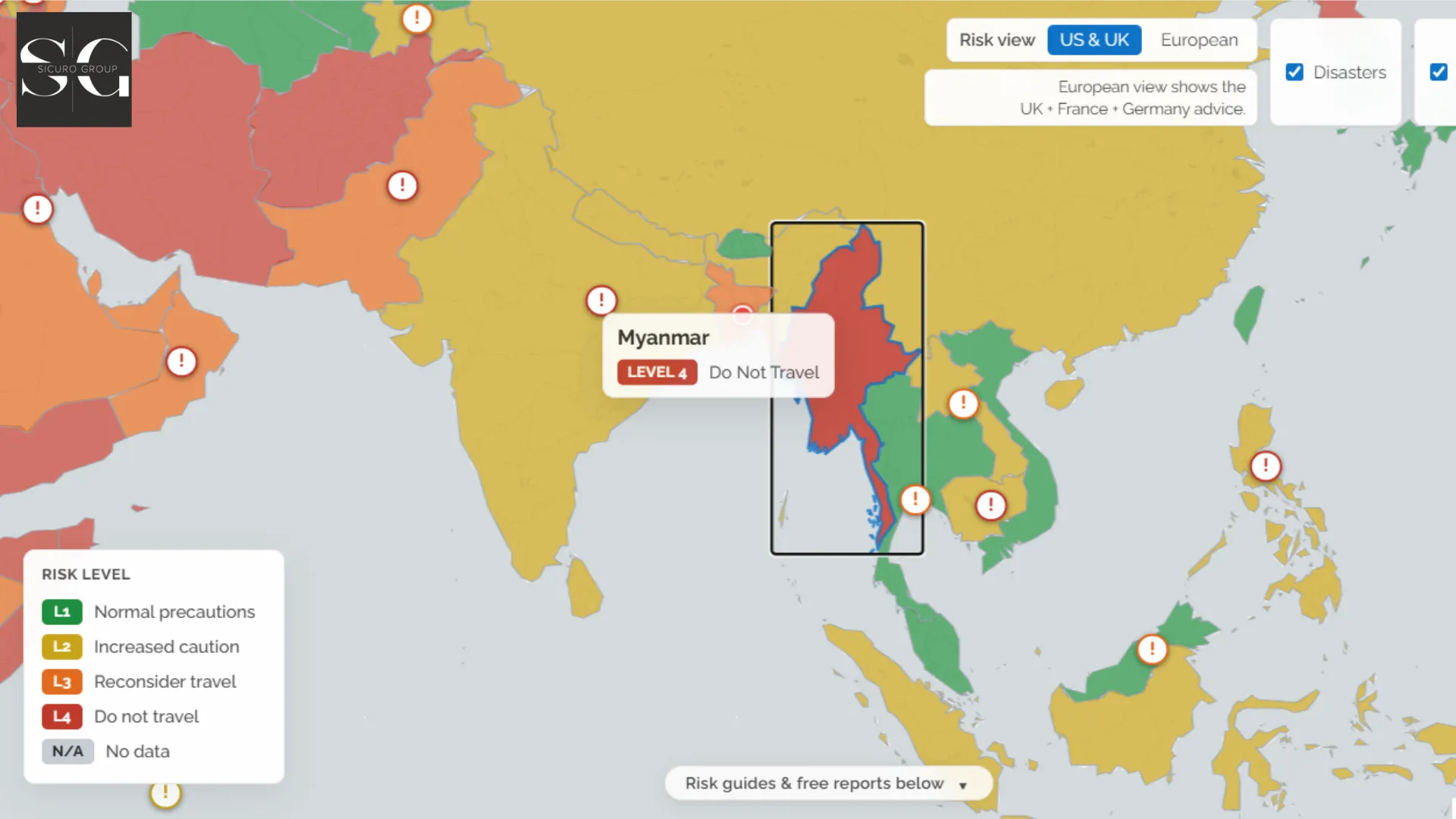
For live travel risk data and updates, visit the Free Travel Risk Map
Is Myanmar Safe?
No. Myanmar has been in civil war since the 2021 coup, and the conflict has spread across much of the country. The military government holds the main cities, including Yangon and the capital Naypyidaw, while resistance forces and ethnic armed organisations control or contest large areas of the borderlands and interior, by some estimates close to half the territory. Air and drone strikes have multiplied, a military-aligned government took office in 2026 after elections widely regarded as neither free nor fair, and the earthquake of 2025 deepened an already severe humanitarian crisis. Major governments advise against travel to most of the country. A thin layer of business and humanitarian operations continues, under structured security. At the time of writing the advisory level is high to maximum depending on region; the live map has the current picture.
The security picture
The dominant risk is armed conflict. Fighting between the military, resistance forces and ethnic armies affects wide areas, with air and drone strikes, artillery and ground clashes, and civilian casualties have risen sharply. Landmines and unexploded ordnance are a growing hazard in conflict zones. Conscription is a live issue: the military has enforced a conscription law, which affects local staff and complicates movement. Arbitrary detention by the authorities reaches those linked to opposition activity or deemed sensitive. Telecommunications and internet shutdowns are used in conflict areas, cutting communications when they are most needed. Yangon and the main cities are calmer relative to the war zones, with crime, occasional unrest and the risk of a sudden security clampdown the practical concerns. Health infrastructure is strained, badly so in conflict-affected and earthquake-hit areas.
Is Myanmar safe to travel?
Download the free ISO 31030-aligned Myanmar risk report on the Sicuro Live Travel Risk Map, updated every 30 minutes from US State Department, UK FCDO, GDACS and WHO sources.
Safety by region
Yangon, Mandalay and Naypyidaw are the most controlled environments and where the limited foreign presence bases, run on arranged terms with awareness of clampdown and unrest risk. Sagaing, Magway, Chin, Kayah, Kayin, Rakhine, Shan and the other conflict-affected states carry active fighting, air strikes, landmines and effective no-go status without a specific operational reason and full security. The border regions with Thailand, China, India and Bangladesh are contested and shaped by ethnic armed organisations and, in places, organised crime including scam-compound networks. Overland travel is dangerous and often blocked. Air movement into the main cities is the standard way in, and field deployment is planned and supported.
Is Yangon safe?
It is calmer than the war zones and the base for the foreign presence, but it sits inside a country at war, with crime, unrest and the risk of a sudden security clampdown. Movement is arranged, not casual.
By traveller type
There is little ordinary business or leisure travel to Myanmar in 2026. The foreigners present work in remaining commercial operations, humanitarian programmes and diplomacy, under structured security. American, British and other Western nationals face detention risk and limited consular reach outside the main cities. Local staff face conscription and detention exposure that requires specific planning. Women on humanitarian programmes operate under the same security model. For everyone, the controlling factors are the conflict, detention risk and communications blackouts, not street crime.
Frequently Asked Questions
Civil war: air and drone strikes, ground fighting, landmines, arbitrary detention and communications shutdowns across much of the country. Conscription adds a layer for local staff.
No. The border regions are contested by ethnic armed organisations and, in places, organised crime, and they carry active conflict. They are not terrain for routine travel.
No. The US advises against travel because of armed conflict, arbitrary detention and crime, with limited consular support outside the main cities.
Yes, comprehensively. Operations run secured accommodation, vetted transport, journey management, communications redundancy for blackout conditions, monitoring and pre-arranged medical and evacuation cover. A light footprint does not fit this environment.
Sicuro Group supports commercial, humanitarian and diplomatic clients across Southeast Asia with intelligence and threat assessment, vetted transport and journey management, secure accommodation advice, traveller tracking with 24/7 GSOC monitoring, medical and evacuation coordination, high-risk travel insurance for the trips and territories standard policies carve out, and SicuroResponse crisis membership with a pre-authorised credit line.
Check the live Myanmar risk level, talk to a Sicuro advisor, or call the 24/7 line on +971 4 362 6378.