
last updated: Aug 5, 2026
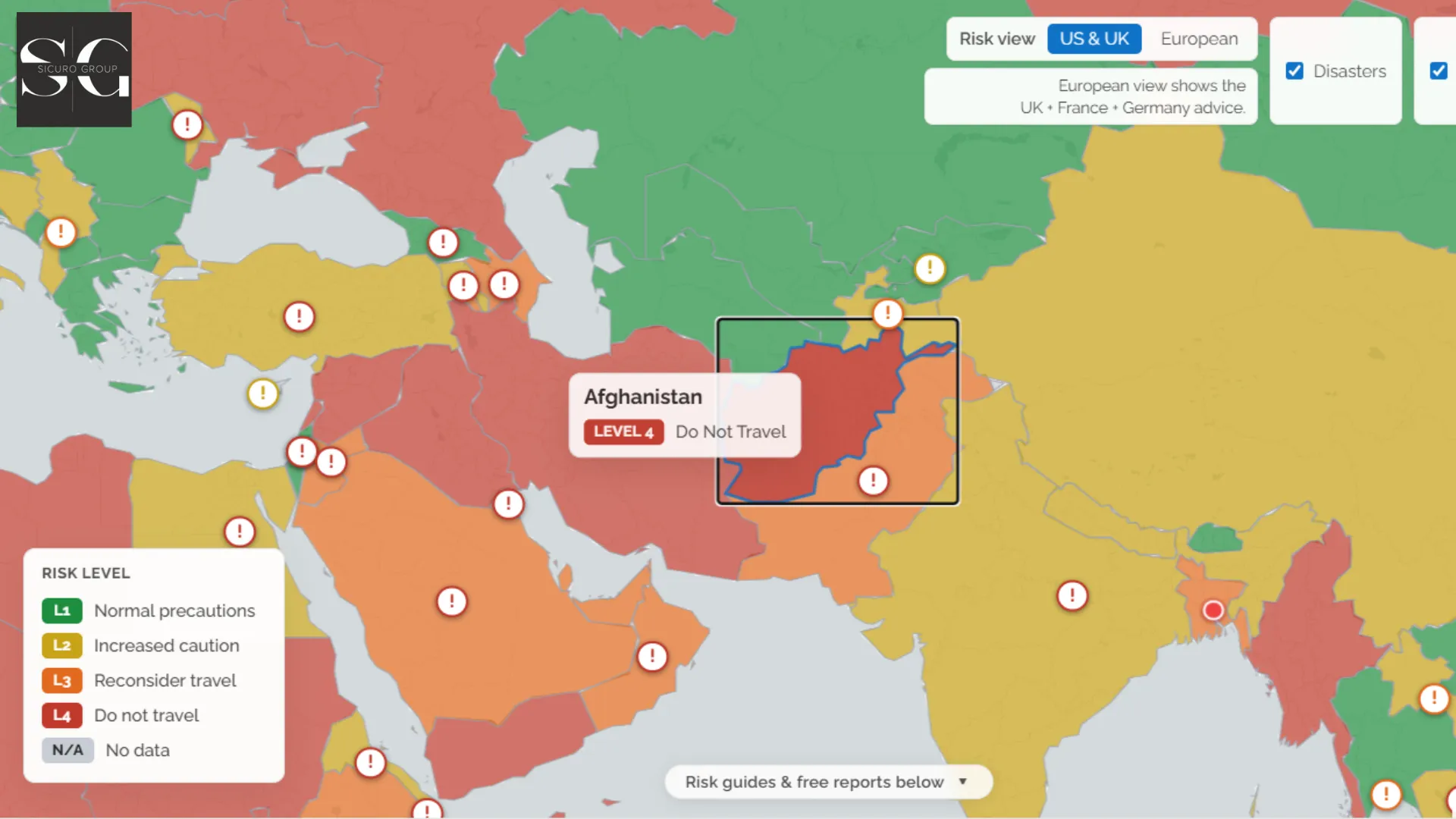
For live travel risk data and updates, visit the Free Travel Risk Map
Is Afghanistan Safe? Travel Risk Guide 2026
Is Afghanistan safe? No, not in the sense most travellers mean, and every major government places it under a do-not-travel advisory. The conventional war ended when the Taliban took Kabul in August 2021, and large-scale fighting has stopped, which leads some to assume the country has calmed. The reality for a foreigner is different: terrorism from the Islamic State Khorasan branch, kidnap-for-ransom risk, arbitrary detention, almost no consular support for many nationalities, and a collapsed health system. A small number of organisations still operate there, mostly humanitarian, and they do it inside heavy security architecture. At the time of writing the advisory level is at its maximum; the live map has the current picture.
The Security Picture
The dominant threat is terrorism. Islamic State Khorasan has attacked mosques, ministries, foreign nationals and Taliban targets, including bombings and complex assaults in Kabul and other cities. Kidnap for ransom is a live risk for foreigners, with criminal and militant actors both involved, and a recovery is slow and uncertain when most embassies have no presence.
Arbitrary detention by the de facto authorities has affected foreign passport holders, sometimes for months. Unexploded ordnance and landmines remain across rural areas after four decades of war. Crime in the cities is lower than the headlines suggest, a function of harsh enforcement, but it is the political and terrorism layers that decide the risk, not street crime.
Is Kabul safe?
No. Kabul carries terrorism, kidnap and detention risk for foreigners. Street crime is suppressed, but that is not the threat that matters here.
Is it safe to travel to Afghanistan?
Download the free ISO 31030-aligned Afghanistan risk report on the Sicuro Live Travel Risk Map, updated every 30 minutes from US State Department, UK FCDO, GDACS and WHO sources.
The Operating Environment
Organisations that work in Afghanistan run a full security model rather than a light footprint. That means vetted local partners, low-profile movement, pre-cleared routes, secure compounds, communications that work when networks fail, and a medical and evacuation plan built before anyone arrives, because in-country care cannot be relied on for anything serious.
Women face severe legal and movement restrictions imposed by the authorities, which shape what female staff can and cannot do and require specific planning. Banking is constrained by sanctions and the collapse of the formal financial sector, so cash logistics become a security problem in their own right. None of this is optional. It is how the humanitarian and diplomatic community functions there now.
By Traveller Type
There is effectively no ordinary business travel to Afghanistan in 2026. The foreigners on the ground are aid workers, UN staff, a handful of journalists, and specialists, all operating under structured security.
American, British and other Western nationals carry an elevated detention and kidnap profile and have little consular fallback, since many missions closed in 2021. Women travelling for work operate under restrictions that have no parallel in most postings and need a plan that accounts for them.
Anyone considering travel for any reason should treat a professional risk assessment as the first step, not a formality.
Frequently Asked Questions
Physically yes, some do, but under do-not-travel advisories, with no reliable consular support for many nationalities, and only with serious security arrangements. Tourism marketed online does not change the underlying risk.
Terrorism from Islamic State Khorasan and kidnap for ransom, followed by arbitrary detention and the absence of medical care. Any one of them can define a trip.
No. US citizens face heightened detention and kidnap risk and minimal consular assistance. The US advisory is do not travel, and it reflects real cases.
Yes, comprehensively. No serious organisation operates there without vetted transport, secure accommodation, journey management, communications redundancy and a pre-arranged medical and evacuation capability. This is the architecture answer, and it is not negotiable.
Sicuro Group supports humanitarian, media and specialist clients operating in Afghanistan and the wider region with intelligence and threat assessment, vetted local networks, journey management and secure movement, traveller tracking with 24/7 GSOC monitoring, medical and evacuation coordination, high-risk travel insurance for the trips and territories standard policies carve out, and SicuroResponse crisis membership with a pre-authorised credit line.
Check the live Afghanistan risk level, talk to a Sicuro advisor, or call the 24/7 line on +971 4 362 6378.