last updated: Aug 17, 2026
For live travel risk data and updates, visit the Free Travel Risk Map
Is the Philippines Safe?
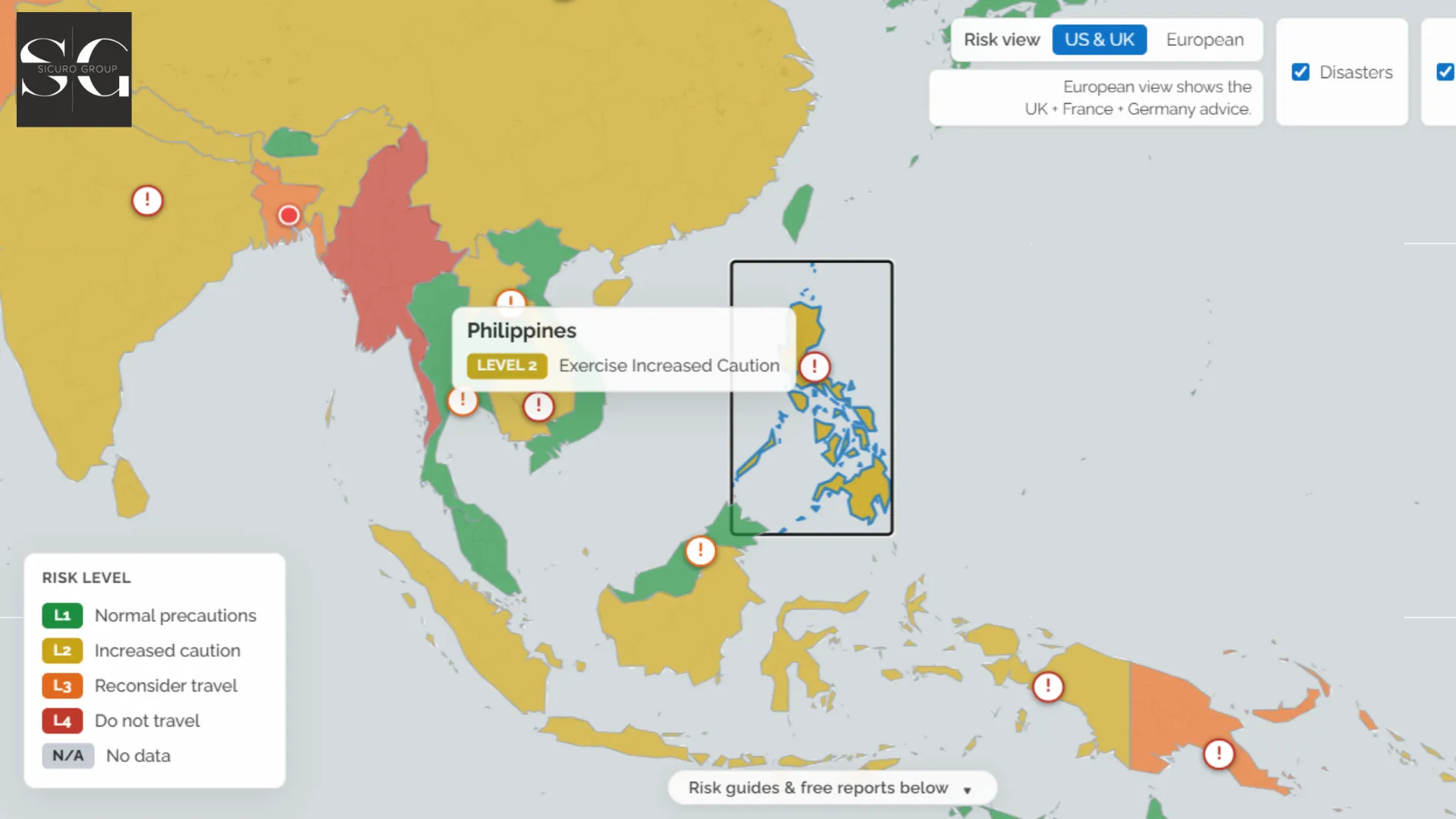
Across the visited archipelago, Manila’s business districts, Cebu, Boracay, Palawan, Bohol, yes, with an easy, English-speaking visitor economy and risks dominated by weather, roads and petty crime. The honest exception is regional and longstanding: the far southwest, parts of Mindanao and the Sulu archipelago, carries kidnap and terrorism risk that sits under the bluntest advisories any government writes, and the gap between that region and the rest of the country is the single most important fact in Philippine risk. At the time of writing the country carries an elevated advisory level; the live map has the current picture.
The Security Picture
Metro Manila’s risks are those of a dense, unequal megacity: pickpocketing and bag-snatching in crowded areas, taxi overcharging that ride apps solve, occasional armed robbery in the wrong districts, and scams aimed at visitors, with the casino-adjacent kidnapping of high-rollers a niche but documented category. Violent crime against ordinary foreign visitors is uncommon, and Makati, BGC and the business corridors run professional, well-secured environments. Demonstrations are frequent and rarely consequential for visitors. The political temperature rises around elections without much touching the visitor economy.
The Typhoon Layer
Around twenty typhoons enter Philippine waters in a typical year, several making destructive landfall. The season peaks from July to October, and the consequences for travellers are flight cancellation waves, island stranding, and in severe events real danger in coastal and low-lying areas. The disciplines are simple: watch forecasts in season, build itinerary slack, follow hotel and local government instructions during events, and for resident operations, treat typhoon continuity planning as core, because Philippine institutions certainly do. Earthquakes and active volcanoes add the Ring of Fire baseline familiar across the region.
Safety by Region
Luzon, the Visayas and the main tourist islands run the standard profile above. Mindanao splits: the northern and eastern cities, Davao included, function as ordinary provincial economies with somewhat elevated baselines, while the western and southwestern zones, the Bangsamoro region, the Sulu archipelago, Basilan and the Zamboanga peninsula, carry kidnap-for-ransom history and militant activity that put them under explicit do-not-travel advisories. The historical record of foreigner kidnappings, including from coastal resorts in the southwest, is exactly why the advisories read as they do. The rule is clean: the advisory map is the itinerary map.
Is Manila safe?
The business districts and tourist zones, yes, with megacity awareness and app transport. The city’s reputation runs worse than its visitor-relevant reality.
Is Mindanao safe?
It depends entirely on where. Davao and the northern cities function normally with elevated baselines. The southwest and the Sulu archipelago sit under do-not-travel advisories for kidnap and terrorism, and they mean it.
By Traveler Type
Business travelers base in Makati or BGC, use ride apps and hotel cars, and find one of Asia’s easiest working environments linguistically and culturally. Women traveling alone rate the main destinations as comfortable, with standard nightlife and transport discipline. American travelers will find deep familiarity and a large expatriate community; the advisory exceptions in the southwest apply to everyone, and online romance and investment scams originating from the region deserve a mention in any personal-risk briefing.
Frequently Asked Questions
When is typhoon season?
Roughly June to November, peaking July to October. Travel runs normally through most of it, with forecast-watching and slack the working answer.
Is the Philippines safe for Americans?
Yes, across the visited geography, with the southwestern advisories taken literally. English everywhere makes it one of Asia’s easiest destinations for Americans.
Do I need security in the Philippines?
Not for the main business and tourist circuits. Any work touching western Mindanao or the Sulu zone requires a professionally built security operation, and coastal resort selection in the far southwest is a security decision, not a leisure one.