

last updated: Jul 11, 2026
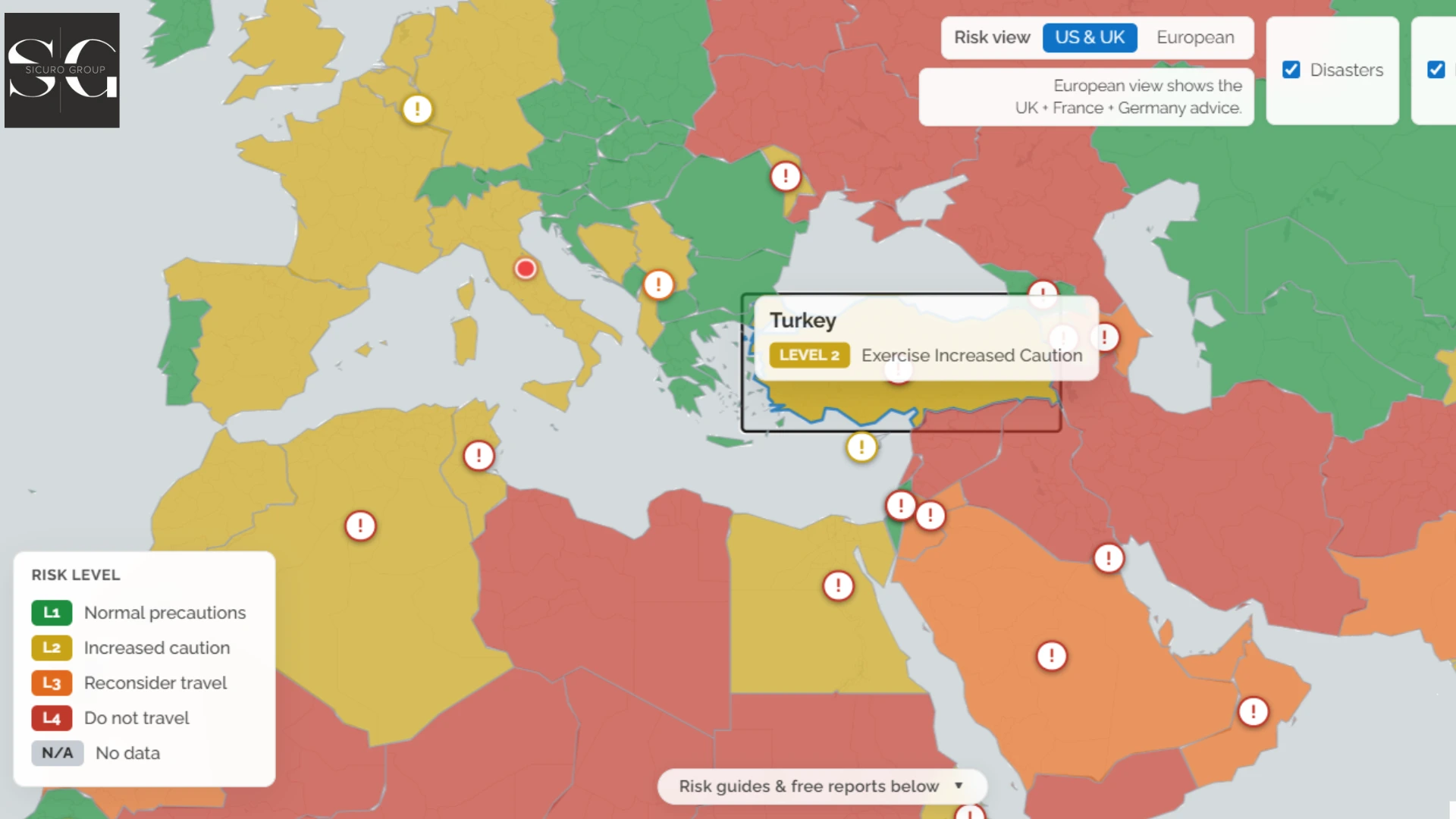
For live travel risk data and updates, visit the Free Travel Risk Map
Is it safe to travel to Turkey right now?
Istanbul hosts millions of foreign visitors and a deep international business community, and for the overwhelming majority the trip is as routine as Madrid or Milan. Turkey’s honest risk picture has four layers worth separating: ordinary urban crime, a terrorism history that the state polices hard, seismic risk that deserves more attention than it gets, and a southeastern border region that is a different operating environment entirely. At the time of writing Turkey carries an elevated advisory level; the live map has the current picture.
Turkey safety and security
Istanbul’s daily risks are those of any vast city: pickpocketing around the tourist core, taxi games, bar scams aimed at lone male travellers, and occasional bag-snatching. Violent crime against foreigners is uncommon. Terrorism is a managed but real layer; Turkey suffered serious attacks through the mid-2010s and isolated incidents since, including the 2022 Istiklal bombing, and the security services run an intensive counterterrorism posture. Demonstrations occur around political moments and are best avoided on principle, since police response can be sweeping. Political tension between Turkey and various neighbours rises and falls without much touching the visitor economy, though it shapes the advisory levels.
Is it safe to travel to Turkey?
Download the free ISO 31030-aligned Turkey risk report on the Sicuro Live Travel Risk Map, updated every 30 minutes from US State Department, UK FCDO, GDACS and WHO sources.
Safety by region (Istanbul, Ankara, Izmir)
Istanbul, Ankara, Izmir, the Aegean and Mediterranean coasts, and Cappadocia form the visited geography and run manageable profiles. The southeast is the exception that the advisories exist for: provinces bordering Syria and Iraq carry residual conflict risk, periodic security operations and movement restrictions, and they sit outside any ordinary business itinerary. The 10km border strip with Syria remains under the strictest advisories. Eastern Anatolia is remote rather than threatening, with winter conditions the practical issue.
Is Istanbul safe?
Yes, Istanbul is generally safe for tourists and business travellers who follow normal big-city precautions. The city’s main risks are petty crime, tourist scams, taxi issues and occasional demonstrations rather than everyday violent crime. Popular areas such as Sultanahmet, Taksim, Galata, Levent and Besiktas host millions of visitors and international businesses each year.
Terrorism remains a managed but real risk in Turkey, and security measures are visible across major cities. Travellers should avoid demonstrations, stay aware of official guidance, and use reputable transport options. Istanbul also carries earthquake exposure due to its location near active fault systems, making accommodation standards and emergency awareness important considerations.
For most visitors, Istanbul remains a practical destination with sensible precautions, similar to other major global cities. Check the latest Turkey risk level before travelling.
Earthquake risk in Turkey
Turkey sits on two major fault systems, and the 2023 Kahramanmaras earthquakes killed more than 50,000 people. Istanbul itself faces well-documented seismic exposure, which is the most under-weighted risk in most corporate travel programmes covering Turkey.
The practical translations: hotel selection should weigh construction era and standards, organisations with permanent offices should treat seismic planning as core continuity work, and travellers should know the basic drill, since the event gives no notice. This risk does not argue against Turkey; it argues for the same preparedness discipline the country’s own institutions now drill.
Turkey safety by traveller type
Business travellers base in Levent, Maslak or Besiktas in Istanbul, or central Ankara, use app-based transport or hotel cars rather than street-hailed taxis, and find the commercial environment sophisticated and fast. Women travelling alone report standard big-city conditions with harassment lower than the Mediterranean stereotype suggests; the usual transport discipline carries the weight.
American and British travellers should be aware that insulting the nation or its founder is a criminal offence and that political commentary on social media has consequences here; the briefing point is brief, and it matters.
Frequently Asked Questions
Yes, with ordinary big-city awareness. The scams around the tourist core are the realistic nuisance; the current level reflects regional and southeastern factors more than Istanbul’s streets.
Sicuro Group supports clients across Turkey and its neighbourhood with pre-travel intelligence, journey management, traveller tracking with 24/7 GSOC monitoring, and SicuroResponse crisis membership with a pre-authorised credit line.
Check the live Turkey risk level, talk to a Sicuro advisor,
or call the 24/7 line on +971 4 362 6378.