


last updated: Jul 26, 2026
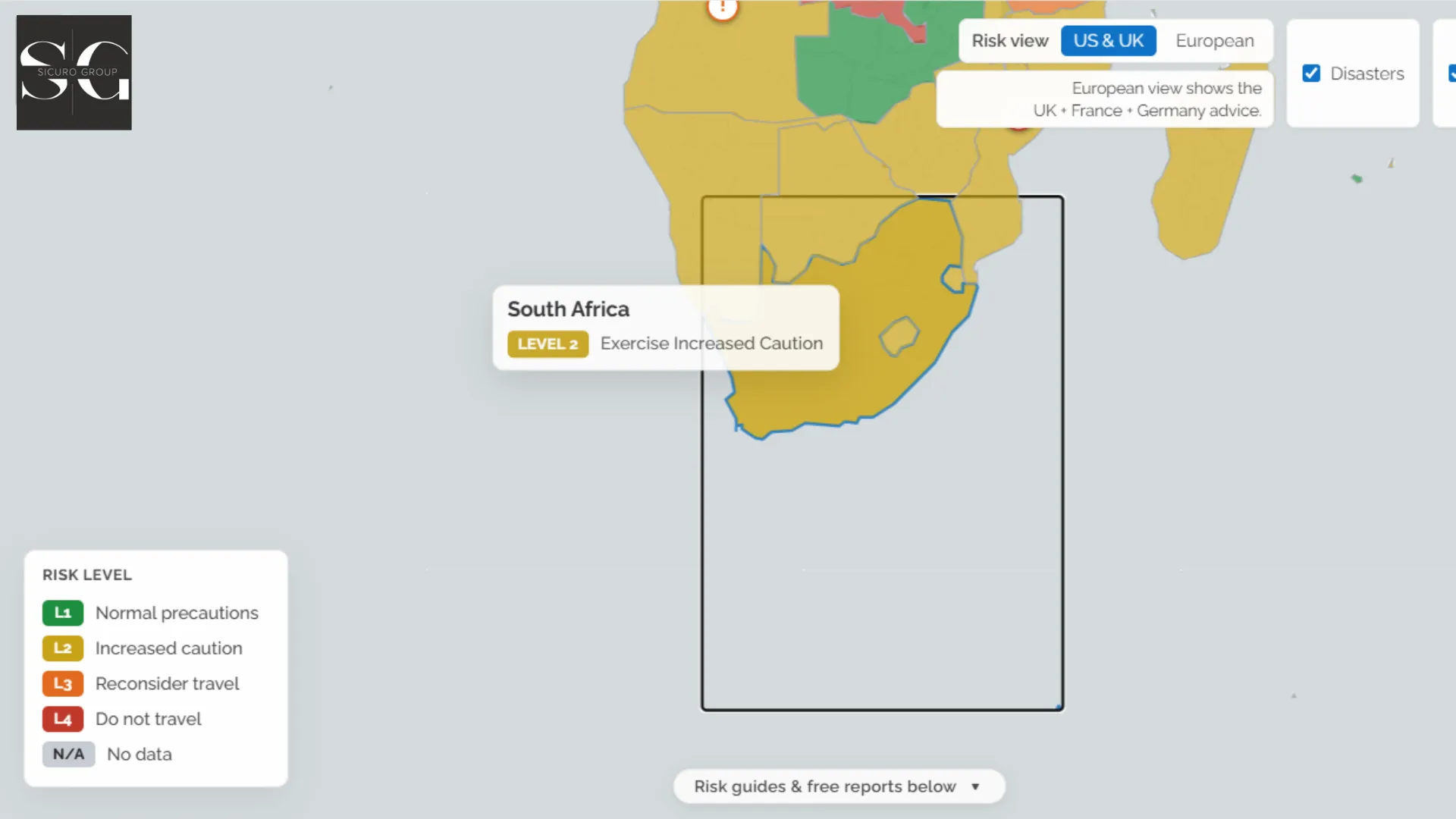
For live travel risk data and updates, visit the Free Travel Risk Map
Is it safe to travel to South Africa?
South Africa carries some of the highest recorded violent crime rates in the world, and it hosts millions of visitors and a deep international business community who overwhelmingly experience none of it. Both facts are true, and the explanation is geography and habit: crime concentrates intensely by area, and the visitor economy runs along corridors engineered to avoid those areas. South Africa rewards travellers who respect the local rules that every resident follows without thinking, and it is unforgiving of improvisation. At the time of writing the country carries a moderate advisory level; the live map has the current picture.
How safe is South Africa?
The national statistics, among the world’s highest for murder and armed robbery, describe a burden carried mostly by townships and specific urban zones that visitors never enter. The risks that actually reach travellers are specific: vehicle crime, including smash-and-grab at intersections and following-from-the-airport robberies in Johannesburg; street robbery for phones and valuables in the wrong areas of the city centres; ATM and card scams; and residential burglary, relevant for long-stay assignees. Carjacking is a real category, concentrated in Johannesburg and on predictable routes at night.
Power infrastructure problems have eased from their worst years but still shape life: traffic lights fail, neighbourhoods go dark, and security systems need backup power. The discipline that manages all of this is locally universal: doors locked while driving, valuables invisible, routes planned, nothing on foot after dark outside the secured precincts, and airport transfers arranged rather than improvised.
Is it safe to travel to South Africa right now?
Download the free ISO 31030-aligned South Africa risk report on the Sicuro Live Travel Risk Map, updated every 30 minutes from US State Department, UK FCDO, GDACS and WHO sources.
Safety by City (Johannesburg, Cape Town, Durban)
Johannesburg is the business capital and carries the sharpest edges: base in Sandton, Rosebank or Melrose, treat the airport route as the known risk it is, and let vetted transport carry the load. The CBD and Hillbrow are not visitor territory.
Cape Town presents a gentler face along the Atlantic seaboard, V&A Waterfront and the wine country, with the same concentrated risk a few kilometres away in the Cape Flats; the mountain trails have their own mugging history, so hike in groups on popular routes at busy hours.
Durban follows the same pattern: beachfront and Umhlanga workable, vigilance elsewhere.
The safari reserves and the Garden Route run low-crime, well-managed visitor economies.
By Traveller Type
Business travellers live in a well-worn groove: Sandton or Cape Town hotels, arranged transfers, ride-hailing apps used kerb-to-kerb rather than street waits, meetings in secured precincts. It works, which is why the corporate community is large and long-established.
Women travelling for business report the same rules carrying the weight, with solo evening movement the main thing to design out.
American and British travellers face no targeting dimension; they face the same geography as everyone else.
Long-stay assignees need residential security taken seriously: estate or secured-building accommodation, alarm response contracts, and the household briefing that residents consider basic.
Frequently Asked Questions
Yes, inside the Sandton-Rosebank groove with arranged transport. The airport route deserves specific respect: cases of following-from-the-airport robbery are documented, which is why transfers are pre-arranged here.
The visitor corridor, yes, among the most enjoyable city destinations anywhere. The discipline is route-specific: established areas, no displayed valuables, group hikes on the mountain, no township visits without organised tours.
The national numbers are severe and heavily concentrated. Visitors who follow resident habits rarely encounter it; visitors who improvise carry most of the incident reports.
Yes, with local rules: doors locked, windows up in town, nothing visible on seats, intersections approached with awareness at night, and long rural drives done in daylight.
Routine business travel needs vetted transport and sensible basing rather than protection. Long-stay assignments need residential security. High-profile visitors, events and site work in difficult areas justify journey management and protective drivers, which is a mature, professional market here.
Sicuro Group supports clients across Southern Africa with pre-travel intelligence, vetted transport and journey management, residential security reviews for assignees, traveller tracking with 24/7 GSOC monitoring, and
SicuroResponse
crisis membership.
Check the live South Africa risk level, talk to a Sicuro advisor, or call the 24/7 line on +971 4 362 6378.