


last updated: Jul 26, 2026
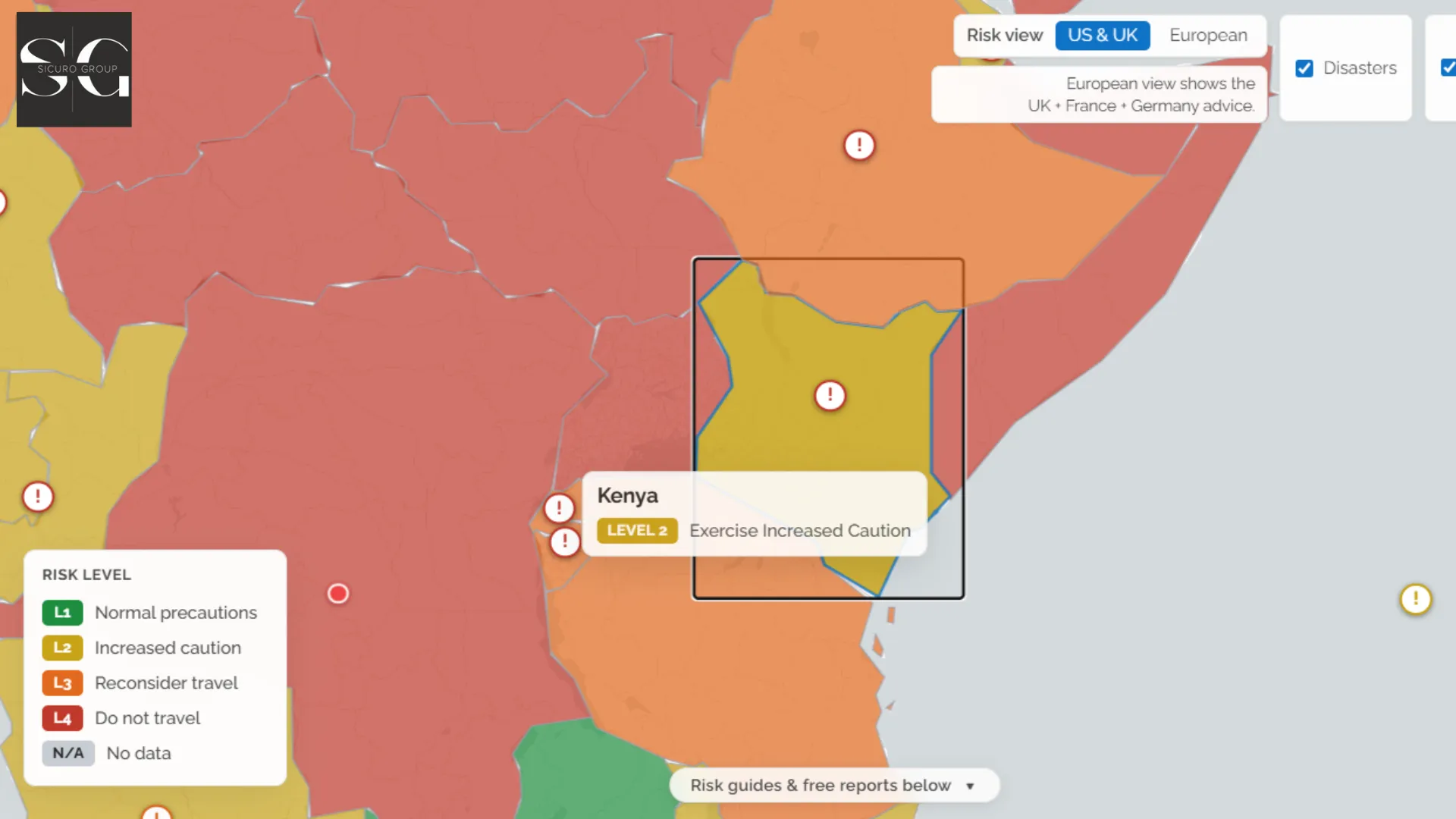
For live travel risk data and updates, visit the Free Travel Risk Map
is Kenya safe to visit?
Safe enough to serve as East Africa’s business capital, hosting the regional headquarters of half the multinationals on the continent and a UN hub, and demanding enough that all of those organisations run real security programmes. That combination is the honest answer.
Kenya rewards the traveller who treats it as a serious working environment and punishes complacency in specific, predictable ways: urban crime in Nairobi and Mombasa, terrorism risk that concentrates near the Somali border, and road travel that is statistically the most dangerous thing anyone does in the country.
At the time of writing Kenya carries an elevated advisory level; the live map has the current picture.
The security picture
Nairobi’s risk is street crime: mugging, vehicle smash-and-grab, phone snatching, and carjacking in the wrong areas at the wrong hours. It is managed the way every resident multinational manages it, with vetted transport, sensible districts, and a refusal to walk after dark with valuables.
Terrorism is the second layer: al-Shabaab has attacked Kenya repeatedly, Westgate in 2013 and DusitD2 in 2019 in Nairobi among them, and the threat persists, concentrated in the northeast and the coastal strip near Somalia but capable of reaching the capital. Security at malls, hotels and offices reflects it; treat the screening culture as protection, not theatre.
Demonstrations, a recurring feature of Kenyan politics in recent years, turn violent often enough that distance is policy.
Travelling to Kenya?
Download the free ISO 31030-aligned Kenya risk report on the
Sicuro Live Travel Risk Map,
updated every 30 minutes from US State Department, UK FCDO, GDACS and WHO sources.
Is there Ebola in Kenya?
No. Kenya has never recorded an Ebola outbreak. The outbreaks that drive the question have occurred in the Democratic Republic of the Congo and Uganda, and Kenya’s surveillance at borders and airports is built precisely because its neighbourhood carries the risk.
The health picture that actually affects travellers is more ordinary: malaria is present at the coast, around Lake Victoria and in the lowlands, though Nairobi’s altitude keeps the capital low-risk; yellow fever vaccination is required if arriving from endemic countries; and food and water discipline prevents most of what actually sends visitors home early.
Private healthcare in Nairobi is the best in East Africa, anchored by hospitals the regional expatriate community relies on; outside the capital, capability thins fast, which is why serious programmes carry evacuation cover.
Safety by region
Nairobi and the central business corridor are the working environment described above.
The safari circuits, the Mara, Amboseli, the conservancies, run professional security and very low crime, with the realistic risks being aviation weather and distance from care.
The coast splits: Diani and the resort strips operate well, while the Lamu region’s proximity to Somalia keeps it under advisories.
The northeastern counties bordering Somalia, and the far northern border areas, are advisory zones where travel needs a reason, a plan and support.
Is Nairobi safe for tourists and business travellers?
Yes, with discipline: vetted transport, established districts, nothing on display, nothing on foot after dark. The city hosts thousands of resident expatriates living normal lives on those rules.
By traveller type
Business travellers base in Westlands, Gigiri, Karen or Upper Hill, move by hotel car or vetted app rides, and fly rather than drive between cities.
Women travelling for business report Nairobi as manageable with the same transport discipline; harassment exists, but it is the road and the late-night walk that carry the real risk.
American and British travellers are the backbone of the visitor economy and welcome; both governments maintain advisories on the border regions that mirror the map above.
Frequently Asked Questions
No, and there never has been an outbreak there. The question belongs to the wider region; Kenya runs surveillance precisely because of its neighbours. Malaria, not Ebola, is the health risk worth planning for.
Yes, in the main business and safari geographies. The US advisory concerns the Somali border regions and certain coastal areas, which ordinary itineraries never touch.
Roads are the country’s most dangerous feature: long-distance night driving combines poor lighting, unpredictable hazards and fatigue. Fly between regions; for road moves, use professional drivers in daylight.
For routine Nairobi business, vetted transport and tracked travel suffice. Field operations, border-adjacent work, NGO programmes and high-profile visits justify journey management and a response arrangement; most resident multinationals run exactly that, which tells you the local consensus.
Sicuro Group operates across East Africa with a Nairobi-anchored network: pre-travel intelligence, vetted transport and journey management, traveller tracking with 24/7 GSOC monitoring, medical evacuation coordination, and SicuroResponse crisis membership with a pre-authorised credit line.
Check the live Kenya risk level, talk to a Sicuro advisor, or call the 24/7 line on +971 4 362 6378.