
last updated: Jul 28, 2026
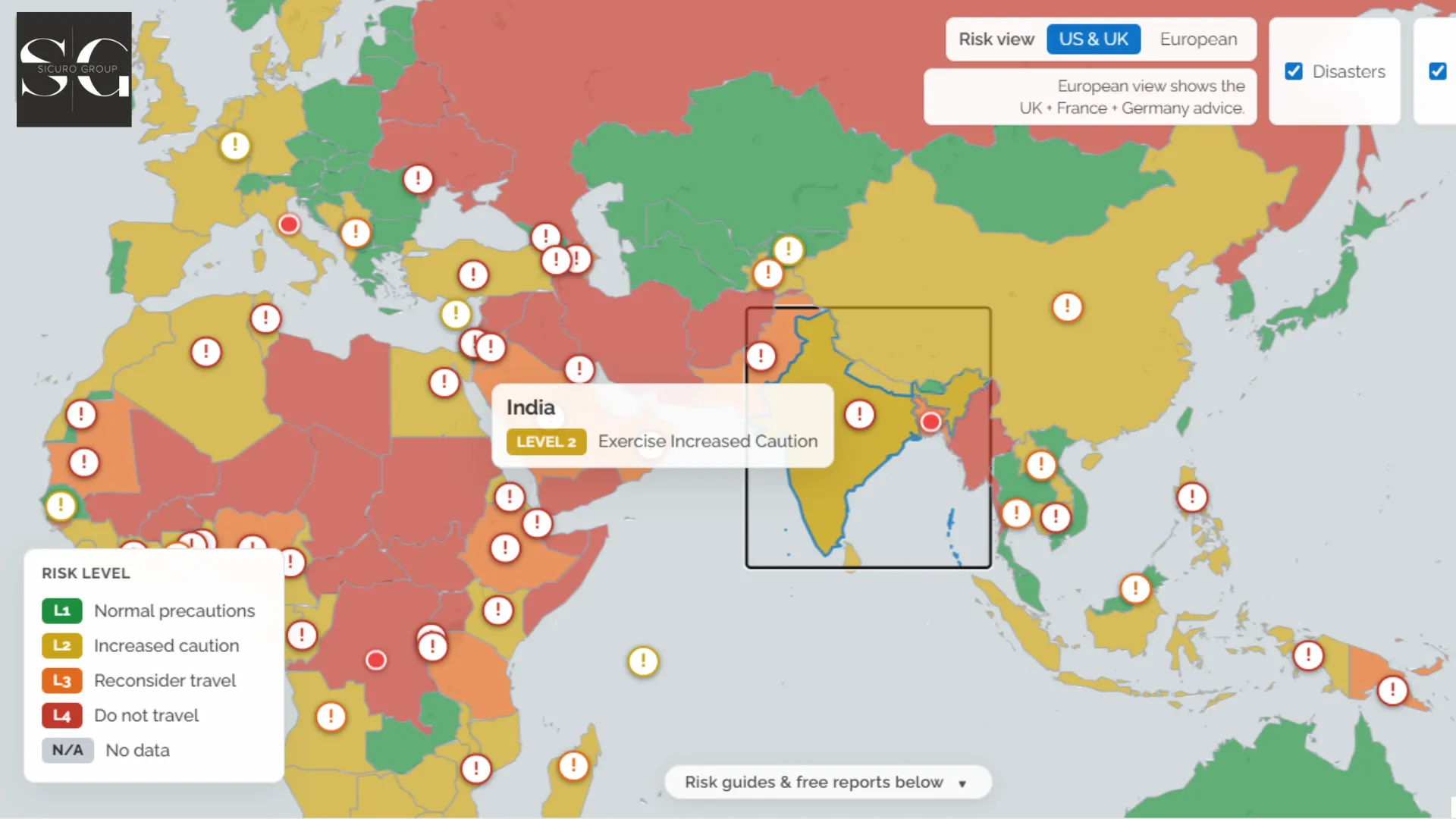
For live travel risk data and updates, visit the Free Travel Risk Map
Is India Safe?
For the business traveller moving between Mumbai, Delhi, Bengaluru, Hyderabad and Chennai, yes, with risks that are mostly practical rather than violent: roads, health, scams and the frictions of scale. India hosts one of the planet’s largest flows of corporate travel, and the multinational community operates with lighter security architecture than in most emerging markets, because violent crime against foreign business visitors is uncommon. The serious caveats are regional and specific, and they sit far from the business circuit. At the time of writing India carries a moderate advisory level; the live map has the current picture.
The Security Picture
Urban risk for visitors concentrates in petty theft, taxi and commission scams around transport hubs and tourist sites, and crowd events, which India produces at scales that deserve respect; stampede tragedies at gatherings are a recurring national story, and dense crowds are best enjoyed with exits in mind. Violent crime against foreign business travellers is rare. Terrorism risk exists at a background level with a history that includes the 2008 Mumbai attacks, and security at international hotels reflects it permanently. The India-Pakistan relationship produces periodic escalations, the spring 2025 exchanges being the most serious recently, with the practical effect on travellers limited to airspace disruption and advisory churn rather than ground risk in the business cities.
Is India safe to travel?
Download the free ISO 31030-aligned India risk report on the Sicuro Live Travel Risk Map, updated every 30 minutes from US State Department, UK FCDO, GDACS and WHO sources.
Safety by Region
The business cities and the tourist triangle run the profile above. The exceptions are well-defined: Jammu and Kashmir carries conflict risk and specific advisories, with the Line of Control region off-limits to ordinary travel; the northeastern border states have their own permit regimes and localised tensions; and the Maoist-affected districts of the eastern interior are a rural insurgency zone that business itineraries never touch. The border areas with Pakistan beyond the Wagah crossing ceremony are military zones. For ninety-five per cent of corporate travel, none of this geography is ever nearby.
Is Delhi safe for business travellers?
Yes, on the standard corporate circuit with arranged transport. Winter air quality is the exposure most programmes underweight.
Is Mumbai safe?
Yes, by emerging-market standards notably so for street crime. Hotel security is permanent and serious for historical reasons; treat it as the norm.
Health and the Road Question
Health does more damage to India itineraries than crime by an order of magnitude. Food and water discipline is the difference between a productive week and a lost one. Air quality in Delhi and the northern plain in winter is a genuine occupational exposure that travellers with respiratory conditions should plan around. Dengue and seasonal disease vary by city and season. Private healthcare in the major cities is excellent and inexpensive by Western standards, with hospital groups that serve medical tourism for a reason. The road is the other big number: India’s traffic fatality statistics are among the world’s highest, and the practical rule for visitors is simple, hired cars with professional drivers, never self-driving, and overnight intercity road travel designed out of itineraries.
By Traveller Type
Business travellers will find the hotel and office infrastructure excellent and the operating rhythm fast; app-based transport works well in the metros, and hotel cars carry the airport runs. Women travelling alone face a risk picture that varies sharply by city and context: the metros’ business districts are routine, while crowded transport and isolated areas after dark warrant real caution, and most programmes specify arranged transport after evening hours. American and British travellers need current e-visas, and should know that drones, satellite phones and certain radio equipment are restricted imports that create genuine legal trouble at customs.
Frequently Asked Questions
The business districts and metros, generally yes with evening transport arranged. Crowded transit and isolated areas after dark are where programmes draw lines.
Self-driving is the wrong answer for visitors. Professional drivers are inexpensive, universal practice, and remove the country’s single largest risk to travellers.
Not for metro business travel. Rural project sites, the advisory regions, large events and high-profile visits justify journey management and local support. Health planning matters more than protection for almost everyone.
Sicuro Group supports clients across South Asia with pre-travel intelligence, journey management, traveller tracking with 24/7 GSOC monitoring, medical case coordination, and SicuroResponse crisis membership.
Check the live India risk level, talk to a Sicuro advisor, or call the 24/7 line on +971 4 362 6378.