

last updated: Jul 21, 2026
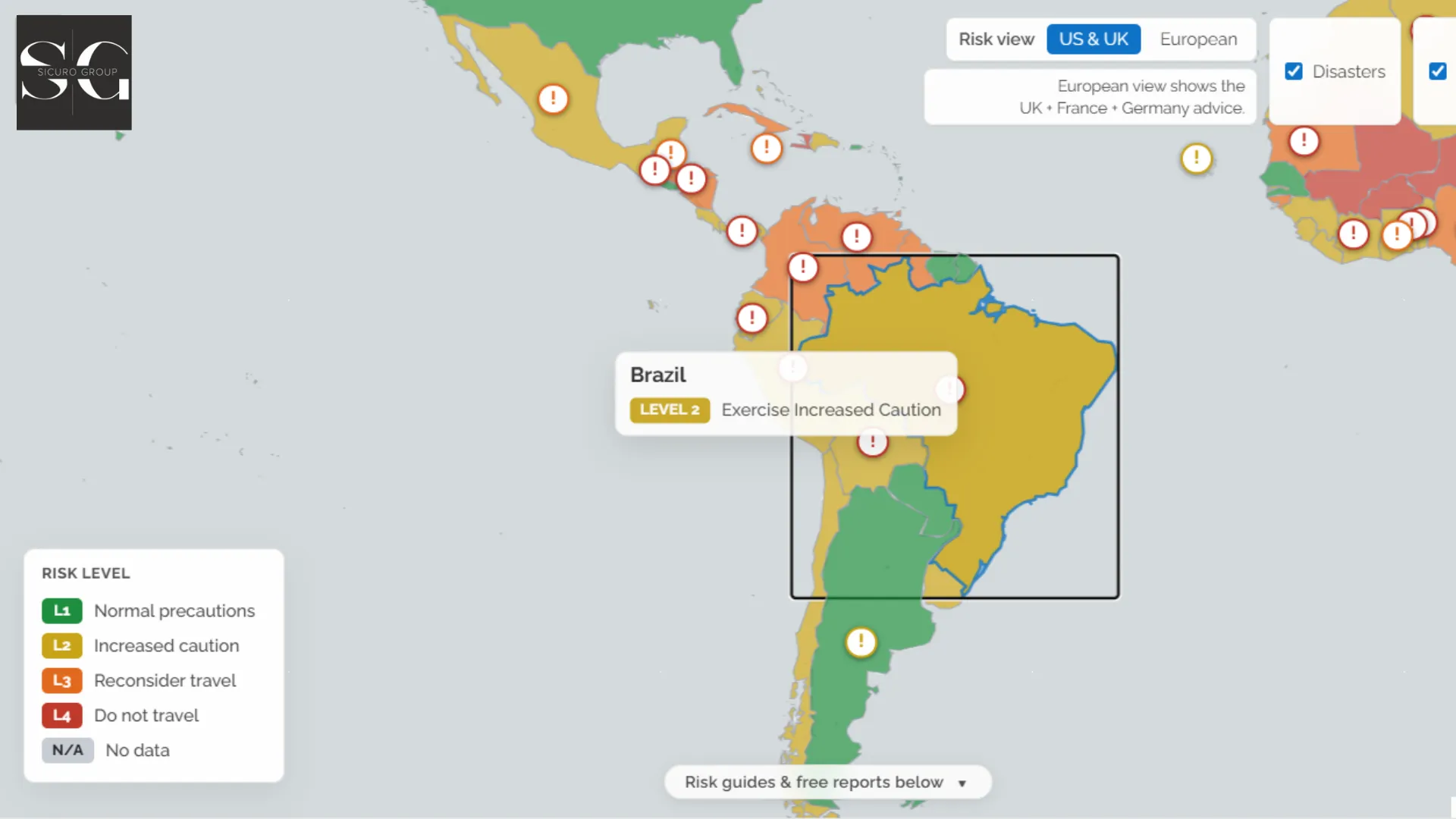
For live travel risk data and updates, visit the Free Travel Risk Map
Is Brazil a safe country?
Brazil hosts the largest international business community in Latin America, and that community operates comfortably inside a set of habits learned from cities where street crime is real, visible and avoidable. The honest answer: violent crime statistics are high, exposure is highly local and behavioural, and foreign business travellers who adopt resident habits experience Brazil as the warm, professional, sophisticated market it is. The ones who treat Rio like Lisbon supply the incident reports. At the time of writing Brazil carries a moderate advisory level; the live map has the current picture.
The security picture
The defining urban risks are robbery, phone snatching above all, often by motorbike pairs, express kidnapping in unregulated transport, and opportunistic theft anywhere valuables are visible. The phone is the central object: snatched by the thousand in every major city, and worth exactly nothing against personal safety, which is why the local rule is to hand it over instantly if confronted. Favela geography matters: the informal settlements interweave with wealthy districts, navigation apps occasionally route through them, and entering without local arrangement is the canonical visitor error in Rio. Armed robbery at traffic lights occurs in known corridors at night, which is why windows-up, doors-locked driving is the resident norm. None of this carries a targeting dimension against foreigners; it is opportunism, defeated by being a hard target.
Is it safe to go to Brazil right now?
Download the free ISO 31030-aligned Brazil risk report on the Sicuro Live Travel Risk Map, updated every 30 minutes from US State Department, UK FCDO, GDACS and WHO sources.
Safety by city (Sao Paulo, Salvador, Manaus, Rio de Janeiro, Recife, Fortaleza)
Sao Paulo is the business capital and the easier security environment: base in Itaim, Faria Lima, Jardins or Vila Olimpia, use app transport door to door, and the working week runs without drama. Rio is more beautiful and more demanding: the Zona Sul beach districts are workable with discipline, phones managed, nothing displayed, beach valuables minimal, app cars after dark, while the north zone and the favela margins are not visitor terrain. Brasilia runs calm and administrative. The northeast capitals carry higher street-crime baselines alongside their tourist economies. Manaus and the Amazon gateways are about logistics and health more than crime. The border arc with Venezuela, Colombia and Paraguay carries trafficking dynamics that ordinary itineraries never meet.
Is Rio de Janeiro safe for tourists?
The Zona Sul circuit, yes, with active discipline: minimal visible valuables, app transport at night, no favela entry without organised arrangements, and instant compliance if robbed.
Is Sao Paulo safe for business travellers?
Yes, comfortably, inside the business districts with app transport. It is the routine posting of Latin America’s corporate world.
Is Salvador Brazil safe?
Salvador is generally safe in tourist areas during the day but has higher street crime than São Paulo. Avoid unfamiliar neighborhoods, keep valuables hidden, and use taxis or rideshares at night.
Is Manaus Brazil safe?
Manaus is reasonably safe in central tourist areas, but crime is more common in outer neighborhoods. Most visitors travel safely by using organized tours and avoiding the city at night.
Is Recife Brazil safe?
Recife’s main tourist areas are generally safe during the day, but robbery remains a concern. Stay in busy areas, avoid walking at night, and note that parts of Boa Viagem beach have shark warnings.
Is Fortaleza Brazil safe?
Fortaleza’s beach and tourist districts are generally safe with normal precautions, while some outer areas experience higher crime. Use trusted transport and avoid isolated places after dark.
By traveller type
Business travellers live the app-transport, established-district, nothing-visible routine, and find Brazilian professional culture warm and relationship-driven. Women travelling for business report the same rules carrying the weight, with solo night movement designed out. American and British travellers attract no special attention; the e-visa requirement for Americans returned in 2025 and needs handling before travel. For everyone, the phone rule is the briefing in miniature: carry a decoy or be ready to surrender it, and never chase.
Frequently Asked Questions
High-volume and opportunistic, centred on phones and visible valuables. Hard targets walk past it daily; soft targets find it quickly.
Yes, with resident habits. There is no targeting dimension; the e-visa paperwork is the only American-specific item.
Routine business travel needs habits, not protection. Executive visits with public profiles, events, favela-adjacent operations and the border regions justify journey management and vetted drivers, a mature market here.
Sicuro Group supports clients across Latin America with pre-travel intelligence, vetted transport and journey management, executive protection for profile visits, traveller tracking with 24/7 GSOC monitoring, and SicuroResponse crisis membership.
Check the live Brazil risk level, talk to a Sicuro advisor, or call the 24/7 line on +971 4 362 6378.